


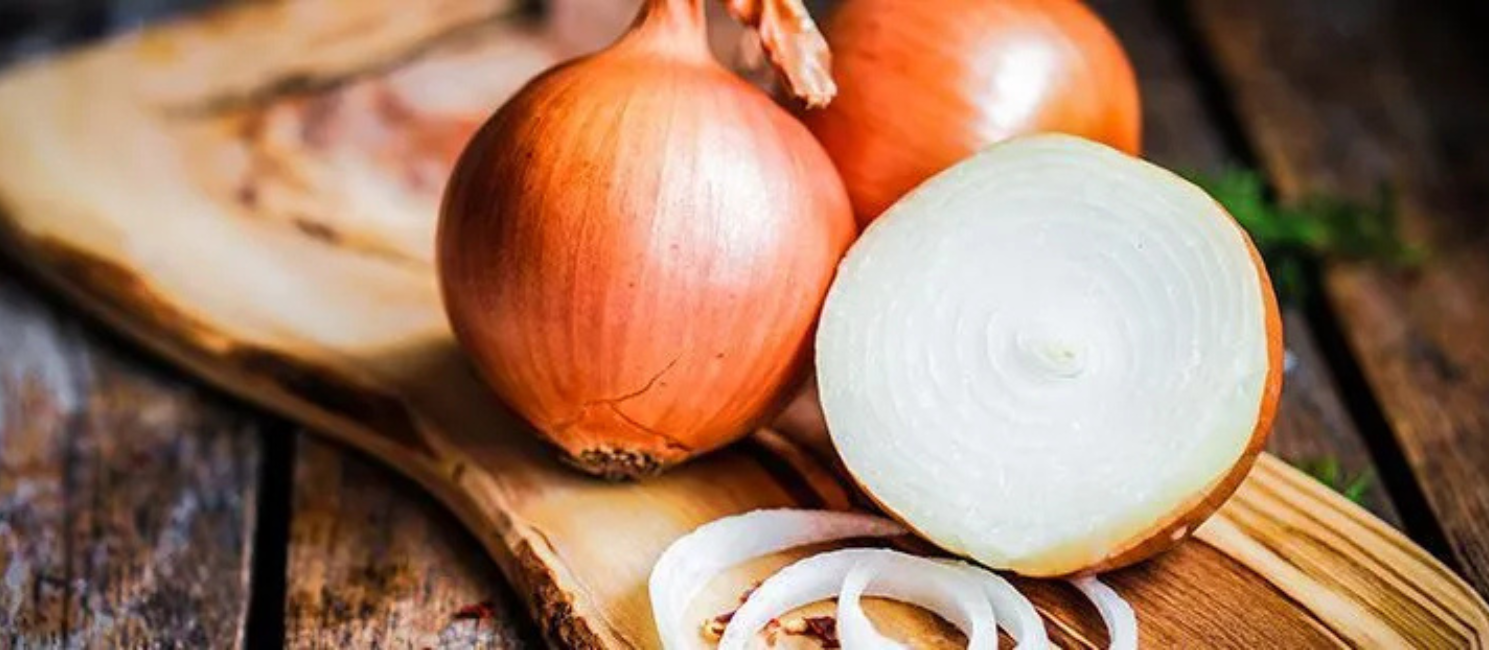
The Big Onions (Freely adapted from: Passioninsieme – “La biònda ad Santarcanzal ad Rumagna. Zvòla da aqua”)
The Santarcangelo onion, also known as the water onion (zvòla da aqua in local dialect), is an early-harvest golden onion that is exceptionally sweet and large in size, sometimes weighing up to a full kilogram. It owes its name to its cultivation method, which requires abundant water—historically drawn from irrigation ditches diverted from the Marecchia River to power local mills.
Until the 1940s, numerous ditches branched off from the Marecchia River, used on a rotating schedule by farmers and millers alike. Local farmers used this water to irrigate vegetable plots where onions, garlic, turnips, and beans were grown. Onions were irrigated using surface flow methods, digging small channels between the crop rows. The traditional growing area spans the lower basin of the Marecchia stream, particularly along the banks near Corpolò. Onions were cultivated wherever Marecchia water channels reached, especially in the town of Santarcangelo, whose residents were affectionately nicknamed cipolloni (zvùléun in dialect, meaning “big onions”) by their neighbors in Rimini.
Sowing takes place in January, followed by transplanting the seedlings in March. Harvesting begins in July and concludes between late August and September. The onions are left in the sun to dry for at least a month before being moved to a cool, shaded area, bound into braids (reste) that keep until November 11th, the feast of Saint Martin, when Santarcangelo hosts its historic annual fair. The water onion is enjoyed both raw and cooked in a vast array of preparations, ranging from simple piadina fillings to intricate sweet and savory dishes.
Seasonality
The onion is harvested from mid-July through late August.
Water onion cultivation flourished throughout the first half of the 20th century before facing progressive decline. It survived thanks to the dedication of a handful of local farmers who passed the tradition down through generations. Today, the Slow Food Presidium supports the local municipality’s efforts to preserve this heirloom variety. Its production code is rigorous: it protects the delicate traditional seed reproduction process and requires sustainable farming practices, such as two- or three-year crop rotations, the exclusive use of organic fertilizer, and a strict ban on chemical herbicides.
Production Area
The municipality of Santarcangelo and parts of the neighboring municipalities of Rimini, Verucchio, and Poggio Torriana along the Marecchia River.
IN 2024, THE SANTARCANGELO WATER ONION WAS OFFICIALLY RECOGNIZED AS A SLOW FOOD PRESIDIUM
Production Specifications of the SLOW FOOD® PRESIDIUM
SANTARCANGELO WATER ONION
Art.1
Name and Description of the Product
The designation Santarcangelo Water Onion refers to the Precoce di Romagna variety. The cultivation technique historically practiced in the soil of Santarcangelo and parts of neighboring municipalities along local waterways has led to it being known as the Water Onion (Cipolla dell’Acqua).
The Precoce di Romagna variety—a long-day onion characterized by a round, flattened bulb that is white and tender on the inside with a light golden yellow outer skin—was widely cultivated across the Romagna region years ago, particularly throughout the Marecchia Valley and within Santarcangelo.
Today, small, rare plots dedicated to growing this valued cultivar can still be found.
Art.2
Production, Packaging, and Processing Area
The production area comprises the municipality of Santarcangelo di Romagna and designated portions of Rimini, Verucchio, and Poggio Torriana, as indicated in the map attached to these specifications.
Art.3
Historical Background
Numerous accounts document that up until the 1940s, several irrigation ditches branched off from the Marecchia River, used on a rotating basis by farmers and millers with mutual respect to preserve limited water supplies. Among local farmers, water was used to irrigate vegetable plots growing onions, garlic, turnips, and beans. Onions were irrigated by surface flow, digging small channels between crop rows. This cultivation technique is believed to be the origin of the popular local name given to the Precoce di Romagna variety: “Zvòla da acqua”.
Art.4
Pedoclimatic Characteristics of the Production Area
Santarcangelo features a sub-continental climate with hot summers and damp, cold winters. Average rainfall is 780 mm, well distributed throughout the year, with two peaks in autumn and spring interrupted by a dry summer. It differs from the rest of Romagna because in Santarcangelo the Po Valley flatlands definitively fade away, resulting in decreased continentality and increased ventilation. Minimum temperatures rise as the cooling effect of the plain diminishes, while breezes at the mouths of the valleys generate microclimatic phenomena of significant interest. For this reason, the thermal inertia is considerable, causing a slower temperature recovery in spring compared to locations further from the sea. The average temperature is 14.5°C, reaching an average of 18.5°C during the growing season.
The lower hills are particularly characterized by this mild climate due to the absence of cooling dynamics associated with the sea and especially the plain. Thermal inversion is a very frequent phenomenon; consequently, the hills are often sunnier than the plain. Near Santarcangelo lies the Natura 2000 site “SIC Torriana, Montebello, Fiume Marecchia”. Located in the alluvial plain of the Marecchia River, the soils are mostly fertile, silty-clay-sandy. In the lowlands and the first hills, the water table lies just a few meters deep, and deposits from the breakdown of blue clay formations characteristic of the Romagna hills yield soils with high qualitative potential.
Art.5
Planting Practices
Seed Production
Mother onions are selected during the harvest period in the summer months, from late July through August. Healthy onions free from defects and aesthetically and morphologically consistent with the Precoce di Romagna variety are selected. Under no circumstances may discard onions from ordinary production be used for seed production, including double-gemini or deformed bulbs.
The mother onion is placed in wooden crates or on a flat surface and stored in a preferably dark environment—and away from direct light—to facilitate proper sprouting.
Once sprouting has occurred, they are planted in the ground: a trench approximately 10 to 15 centimeters deep is dug, and the onions are placed inside at a distance of about 30 centimeters from one another, with an inter-row spacing of approximately 40 centimeters. They are then covered, leaving only a small portion of the sprout visible above ground.
When flower stalks reach a height of about one meter, a globose umbel (commonly called a “fiocco” or tuft) forms at the top containing small flowers. Seeds form inside as tiny grains that turn black upon maturity.
Once ripe, the umbels are harvested and placed on a cloth exposed to the morning sun for 2 to 3 days to dry; drying is then completed (approx. 20 days) in a shaded, well-ventilated space.
Seed Extraction
The umbels (fiocchi) are rubbed against a work surface using a stone or a flat piece of wood. Once completed, the extracted material is poured into a container of water; due to density differences, viable seeds—being heavier—settle to the bottom, while floating debris is discarded. The seeds are placed in the morning sun to dry for 3 to 4 days, followed by another 8 to 10 days of drying in the shade with active air circulation.
Seed Production Area
The producer must declare the plot/parcel where the seeds were produced and where the mother onions were planted, providing an estimated seed yield or indicating seed purchase origin from an affiliated producer.
Seedling Production
Traditional production: each producer raises their own onion seedlings.
Nursery production: seedling production in a nursery is permitted.
Producers may use a nursery (located within a maximum distance of 50 km from Santarcangelo) provided the following conditions are met: the producer must guarantee, via written self-certification, that the seed delivered to the nursery was produced from mother onions grown in Santarcangelo. The producer must also state the quantity delivered and the estimated number of seedlings to be raised. The nursery must certify that seedlings will be raised using seed produced in Santarcangelo and commit to raising seedlings (from seed) in cell trays using virgin growing substrate.
Fertilization and Soil Management
Fertilization must primarily utilize organic fertilizers. Preference should be given to compost produced on-farm or mature manure sourced from local or farm livestock.
Weeding or hoeing is performed periodically, executed manually or using rotary cultivators, harrows, or tillers where feasible. Herbicides or similar chemical treatments are strictly prohibited.
Crop Rotation
Onions must follow a crop rotation schedule; every two to three years of onion cultivation must be rotated with different crops for 5 to 6 years (e.g., rotation with wheat, peas, or legumes).
Crop Protection
Phytosanitary protection should preferably rely on organic pest management techniques. If integrated pest management techniques are used, reference must be made to the integrated production guidelines of the Emilia-Romagna Region (applying the lowest dosage and minimum number of interventions foreseen).
Sowing
Sowing generally takes place by mid-January; traditionally, sowing was completed by St. Anthony’s Day (January 17th).
Soil preparation is performed via shallow plowing and, if necessary, tilling.
Sowing can be done manually or mechanically using pneumatic seeders in double rows approximately 20 cm apart, with seeds deposited about 20 cm from each other. Chemical seed dressing is prohibited. Upon completion of sowing, the soil must be compacted to prevent frost damage.
When using traditional seeders that lay seeds in a continuous row, thinning out excess seedlings is required once plants reach 15 cm in height.
Germination depends on seasonal weather; seedlings typically emerge in late March (coinciding with the feast of St. Joseph).
When seedlings are raised in a nursery, transplanting takes place in March following double-row spacing guidelines.
The water onion requires abundant water to develop properly. Depending on weather trends, irrigation must begin as early as March, especially during dry seasons. In June and throughout the hottest months, irrigation is required every 3 to 4 days to keep the soil consistently moist.
In May, excess seedlings are thinned if necessary, ensuring a minimum spacing of at least 20 cm between bulbs to prevent them from touching as they grow.
Harvesting and Storage
Harvesting of sown onions begins in mid-July, while transplanted onions are harvested starting in August. Harvesting is performed strictly by hand: this onion is extremely delicate, and mechanical harvesting almost inevitably causes bruising and rot. Onions are pulled up and left in the sun for 2 to 3 days to dry, which further accentuates their golden color. The foliage dries and begins to peel away, at which point they are ready to be boxed for sale.
Tradition also calls for selling water onions braided into bunches (“resta”). Braiding is performed while the foliage is not yet completely dry.
After harvest, onions can be stored until November in a dark, well-ventilated space. Chemical treatments designed to extend storage life are strictly prohibited.
For fresh marketing, variable-weight packaging up to a maximum of 10 kilograms is permitted in mesh bags, cardboard boxes, or wooden crates, with a narrative label included inside. Processed goods are exempt from this rule; procedures for processed products are detailed in specific annexes to these specifications.
Art. 6
Processed Products
All products utilizing raw materials grown in the fields of producers belonging to this Slow Food Presidium and adhering to the regulations set forth in these production specifications are recognized as processed products of the “Cipolla dell’Acqua di Santarcangelo” Slow Food Presidium.
The following items are officially recognized as processed products made from the Santarcangelo Water Onion Slow Food Presidium:
Caramelized water onion with Balsamic Vinegar of Modena PGI. Ingredients: water onion 150%, cane sugar, Balsamic Vinegar of Modena PGI 15%.
Sweet and sour Sangiovese onion with red wine. Ingredients: water onion, sugar, honey, lemon juice, cloves.
Water onion compote. Ingredients: water onion, water, Sangiovese red wine, wine vinegar, sugar, black pepper, and salt.
All processed products must be produced by Presidium-affiliated growers, individually or as a cooperative, within 5 days of field harvest. Third-party processing is permitted provided prior authorization is obtained from the National Office of Italian Presidia and relevant guidelines are respected.
Processed goods under these specifications are identifiable by the Presidium logo on their label following execution of the corresponding agreement; regarding taste and quality, all products must obtain prior approval from the National Office of Italian Presidia through panel testing.
Art. 7
Labeling
In order to offer consumers maximum transparency regarding production practices, producers shall affix the narrative label to fresh and/or processed Presidium products. The narrative label does not replace legally mandated labeling, but holds legal value and complements standard information by detailing fundamental stages of the production process.
Art. 8
Marketing
Products meeting the requirements of this document must be marketed with the Slow Food Presidium logo and the narrative label to ensure full transparency for consumers. Producers commit to minimizing packaging, prioritizing recyclable, biodegradable, and compostable materials whenever possible.
Art. 9
Inspections and Control
Compliance control relies on self-certification through the narrative labeling tool. In addition, producers are subject to potential verification visits at their farm premises by representatives appointed by Slow Food headquarters. If requested, producers shall supply supporting documentation for further review.