


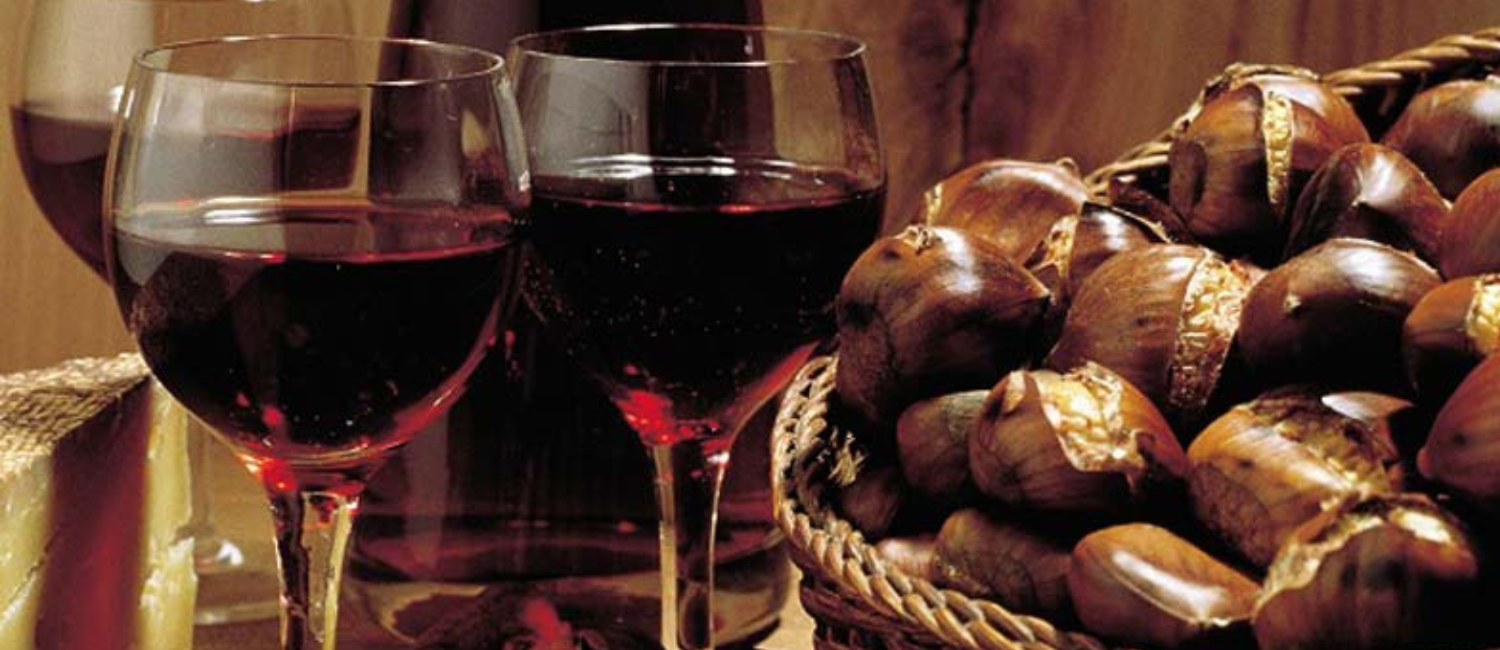
The name Sangiovese was born in Santarcangelo.
An ancient legend, passed down by our grandparents, tells that centuries ago the local Franciscan friars were major producers of red wine.
One day, inside the monastery, they organized a banquet in honor of a very distinguished guest. To make a fine impression, they served him the best red wine from their cellar.
The guest was delighted and immediately asked for its name.
After an initial moment of hesitation, one friar suddenly stood up and exclaimed “Sanguis Jovis”, meaning “Blood of Jove”—inspired by the deep red color of the wine and the name of Mount Giove, the hill where Santarcangelo stands.
Over time, the two words merged into a single name, “Sangiovese”, and the title spread across all of Romagna.
We, the people of Santarcangelo, are immensely proud of it!!!
Lending support to the legend, the Austrian linguist Friedrich Schürr (1888–1980)—Tribune of Romagna Wines and a renowned scholar of the Romagnol language—maintained, following extensive research, that the name “Sangiovese” indeed originated from Mount Giove, around which the magnificent medieval citadel of Santarcangelo developed.
Cardinal Ersilio Tonini, the famed Archbishop of Ravenna, used to joke that the people of Romagna hold special devotion for only one saint: San Giovese!
The Origin of the Name Sangiovese
(from “Il Sangiovese” history, recipes, curiosities by Michele Marziani and Roberta Sapio, published by Nda Press, 2006)
The earliest records of the grape variety named Sangiovese date back to the 17th century, and its origins are shrouded in legendary mystery. Its curious name, which sounds like ”sanzve’s” in Romagnol dialect, appears to derive from Mount Giove (Colli Jovis), a hill located in the hinterland of Rimini, near beautiful Santarcangelo di Romagna. However, the name also alludes to “Sanctus Zeus”, the Jupiter/Jove of the Romans. It is worth noting that Pliny the Elder is believed to have referenced it in his writings as one of the most prized wines of antiquity.
The people of Santarcangelo love to think of Sangiovese as a native vine and support the hypothesis proposed by linguist Friedrich Schürr, Tribune of Romagna Wines, who posited that the original geographical location of this grape variety might well be the Mount Giove area.
Conversely, authors Beppe Sangiorgi and Giordano Zinzani in “Sangiovese vino di Romagna Storia e tipicità di un famoso vitigno e di un grande vino” (published by Feltrinelli) challenge this theory, placing the origin of the name in the mountain passes (gioghi) of the Tuscan-Romagnol Apennines between Marradi and Firenzuola, and tracing its original spread to the Faenza-Imola area under the names uva sanzuvesa and Sangiovese, attested in documents from 1651 and 1672 respectively.
In 1977, the Tribunato Vini di Romagna, together with Ente Tutela Vini Romagnoli, Società dei Passatori, and the Sommelier Association of Italy, placed a commemorative stone on Mount Giove bearing this inscription: “Here on the hill / named after Jove / today, XXIX October MCMLXXVII / the Romagna of Wines / and Vineyards / crowns the brow of the Deity / with the halo / of San-Giovese / claiming / with certainty of faith / its fertile primogeniture.”
Characteristics of Sangiovese
(from “La Romagna dei Vini” edited by Alteo Dolcini and Tommaso Simoni in collaboration with Adriano Fiore, published by Alfa Bologna)
The typical production zone for DOC “Sangiovese di Romagna” includes the territories of: Imola, Dozza, Borgo Tossignano, Casal Fiumanese, Fontanelice, Castel S. Pietro Terme, and Ozzano in the Province of Bologna; Faenza, Brisighella, Castel Bolognese, Riolo Terme, and Casola Valsenio in the Province of Ravenna; Rimini, Morciano, S. Marino, S. Arcangelo, Verucchio, Savignano, Cesena, Mercato Saraceno, Forlimpopoli, Meldola, Bertinoro, Predappio, Castrocaro-Terra del Sole, Modigliana, Rocca S. Casciano, Civitella, and S. Sofia in the Province of Forlì.
SANGIOVESE PICCOLO
(Dialect name: ”Sanzvés”)
A clone widespread in the Forlì area, especially around Predappio and Mercato Saraceno.
GRAPES: Small, loose, conical-cylindrical clusters; visible, thin, semi-woody peduncle; medium-length green pedicels with an evident ring and short brush; berries detach easily.
BERRIES: Medium-small, ellipsoid-spherical, with a persistent navel; skin is pruinose and violet-black; pulp is juicy, slightly pinkish, with a neutral sweet taste. Seeds average 2 per berry, pear-shaped and dark.
PHENOLOGICAL AND AGRONOMIC TRAITS: A moderately vigorous vine with a spreading growth habit, offering medium yet consistent productivity. Early bud break. In warm, sunny areas, it yields a truly superior quality wine: dry, robust, richly colored, tannic, aromatic, highly alcoholic, long-lived, and highly prized.
SANGIOVESE GROSSO
(Dialect name: ”Sanzvès gröss”)
An ancient clone widespread across the hills of Ravenna, eastern Bologna, and Forlì, particularly in the area of Santarcangelo di Romagna.
GRAPES: Medium-large, generally compact, conical-pyramidal clusters; visible, herbaceous, thin peduncle; medium pedicels with a distinct, rusty-green ring and short green-pinkish brush.
BERRIES: Large, spheroid-ellipsoid, with regular cross-section, easily detached from the pedicels; tough, pruinose violet-black skin with a persistent navel; juicy, slightly pinkish pulp with a neutral taste. Seeds average 3–4 per berry, pear-shaped with a slightly thick beak.
PHENOLOGICAL AND AGRONOMIC TRAITS: One of the most quintessential vines of Romagna, moderately vigorous and consistent in yield. Early bud break and flowering. Ripening occurs during the first half of October. The grapes yield a good amount of must; the wine is well-colored, dry, tannic, full-bodied, aromatic, and excellent in alcohol content; it is highly sought after and exceptionally suited for pairings with roast meats.
Popular Sayings and Proverbs
(from “Il Sangiovese storia, ricette, curiosità” by Michele Marziani and Roberta Sapio, published by Nda Press, 2006)
The Romagna wines par excellence are Sangiovese, Trebbiano, and sweet Cagnina. As the local saying goes: “Contra i pinsir un gran rimedi l’è e’ bicir” (Against worries, a glass of wine is a great cure).
“Pàn ad gran, ven’d tarbiàn, fug’d querza, e una bela dona, nenc s’l’è guerra” (Wheat bread, Trebbiano wine, an oak wood fire, and a beautiful woman, even if she’s cross-eyed).
“Frè Pignàt e dbeva e’ sanzves int la bocia de lat” (Friar Pignatta used to drink Sangiovese straight out of the milk bottle).
“Par San Simone us fora la bota de cantòn” (On St. Simon’s Day, tap the corner barrel).
“Par San Martèn us bev e’ bon ven” (On St. Martin’s Day, drink the good wine).
“Chocolate, punch, coffee, rum, beer, mixed grains, and julep, and cider, and tea—as long as there is wine in the world, you will never be for me.” (Abbot Giuseppe Piolanti)
Cagnina, Cagnina,
All the blessed friars owe you,
All the merry priests owe you,
Kings owe you until three,
The master drinks you at breakfast,
And I drink you too, by the grace of God.
(Gianni Manzoni)
TO SANGIOVESE
I am Tuscan, and there are many of us,
And I was born right in the tenth month,
I’ve always heard people talk about Chianti,
Yet here I am writing about Sangiovese.
I’m a teetotaler too, I don’t drink wine,
Making me the best person to speak of its bliss,
A bit like Saint Augustine does
When speaking of vice and lust.
All I need is a single red grape hanging there,
The scent of the vines, and like a hummingbird
I fly into the sky as if I had taken
Forty grams of LSD.
The foundation of all wines, Sangiovese
Is the star of the world’s grapevines,
They make Chianti with it, and Piedmontese wine,
Maybe they even make Nutella with it.
Sangiovese is free of flaws,
It is the spark of every wine’s virtue,
Compared to it, even champagne
Becomes a vulgar chamomile tea.
Drink Sangiovese, the dark one,
You’ll live to be a hundred thousand years old,
It’s good for your health, and I assure you
It’ll make you make love ten times in a row.
Roberto Benigni